

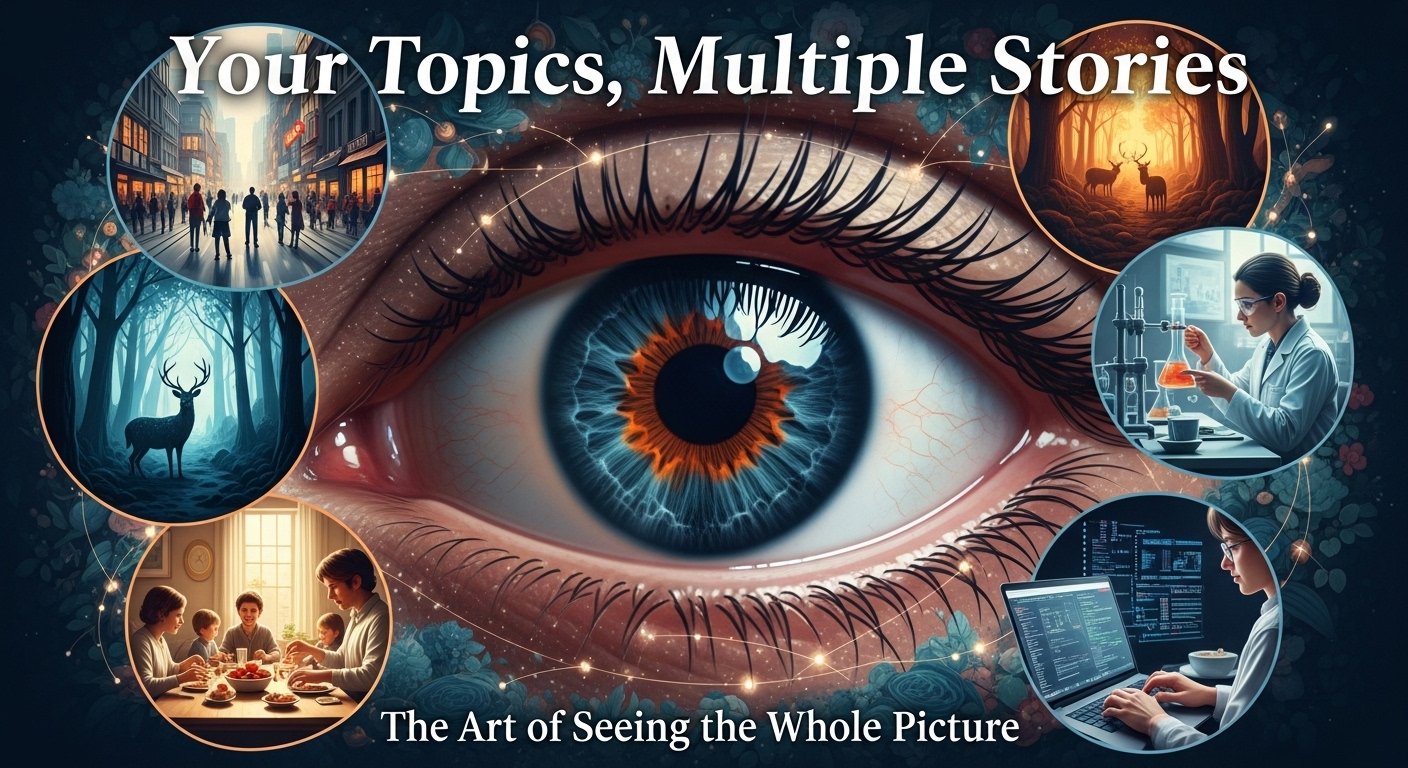
In the age of information, we are often told to “stay on topic.” We crave the singular headline, the clean narrative, the one answer that explains everything. But life, history, and human creativity do not work that way. They operate on a simple, profound principle: Your topics contain multiple stories.
Whether you are a writer, a marketer, a historian, or simply a curious mind, the most powerful skill you can develop is the ability to look at a single subject and see the dozen narratives hiding beneath its surface.
The Trap of the Single Story
The Nigerian author Chimamanda Ngozi Adichie famously warned about “the danger of a single story.” When we assume a topic has only one angle—politics only about power, a brand only about profit, a person only about their struggle—we flatten reality.
For example, take the topic of “Water.”
-
One story: A scientific resource (H2O).
-
Another story: A commodity (bottled water prices).
-
Another story: A human right (access in developing nations).
-
Another story: A spiritual symbol (baptism, ritual cleansing).
-
Another story: A muse (ocean poetry, rain in cinema).
The topic did not change. But the stories did. And depending on which story you tell, you evoke a completely different emotion and action.
Why “Your Topics” Deserve Multiple Narratives
When you claim a topic—whether it is “artificial intelligence,” “motherhood,” “climate change,” or “small business”—you are not claiming a single definition. You are claiming a universe of perspectives. Here is why embracing multiple stories strengthens your work:
1. Depth Over Surface
A single story tells what happened. Multiple stories tell why it matters to different people. If you run a coffee shop, one story is “we sell beans.” The other stories are: the farmer’s harvest, the morning ritual of a tired parent, the first date that happened at table four, and the barista learning latte art to pay for college.
2. Empathy Through Variety
Reading multiple stories about the same topic builds cognitive empathy. You learn that your opponent in an argument is not evil—they are just living inside a different story about the same facts. A debate about “taxes” is really a clash between the story of “community investment” and the story of “individual freedom.”
3. Creative Abundance
If you are stuck creating content (blogs, videos, lessons), the problem is rarely a lack of topics. It is a lack of stories per topic. Take “exercise.” Instead of writing one generic post, write ten:
-
The story of the injured athlete coming back.
-
The story of the busy mom finding five minutes.
-
The story of the science of dopamine.
-
The story of a workout as a rebellion against sitting all day.
How to Uncover Multiple Stories in Your Topic
Ready to apply this? Next time you sit down to write, teach, or present, run your topic through this simple framework:
1. The Functional Story (What does it do?)
2. The Emotional Story (How does it feel?)
3. The Historical Story (Where did it come from?)
4. The Contradiction Story (Who disagrees about this, and why?)
5. The Personal Story (What is my specific memory of this?)
If you do this for one hour, you will never again say, “I have nothing to say about my topic.”
Real-World Example: The Topic of “A Key”
-
Story 1: A locksmith’s daily grind of cutting metal.
-
Story 2: A teenager getting their first house key—a symbol of responsibility.
-
Story 3: An archaeologist finding a 2,000-year-old Roman key, unlocking a forgotten civilization.
-
Story 4: A prisoner dropping their key into a guard’s hand on release day.
-
Story 5: A musician using piano keys to compose a farewell song.
One topic. Five stories. Five different audiences moved.
Conclusion: Be the Curator, Not the Censor
The world does not need another person shouting that there is only one way to see a topic. It needs you to stand at the intersection of your topics and say, “Look closer. There is more than one story here.”
So whether you are building a brand, teaching a class, or just talking to a friend, resist the single story. Pull up a chair. Ask the second question. Find the hidden narrative. Because in the end, the topics you care about are not monoliths—they are libraries. And every library is filled with multiple stories, all waiting to be told.