

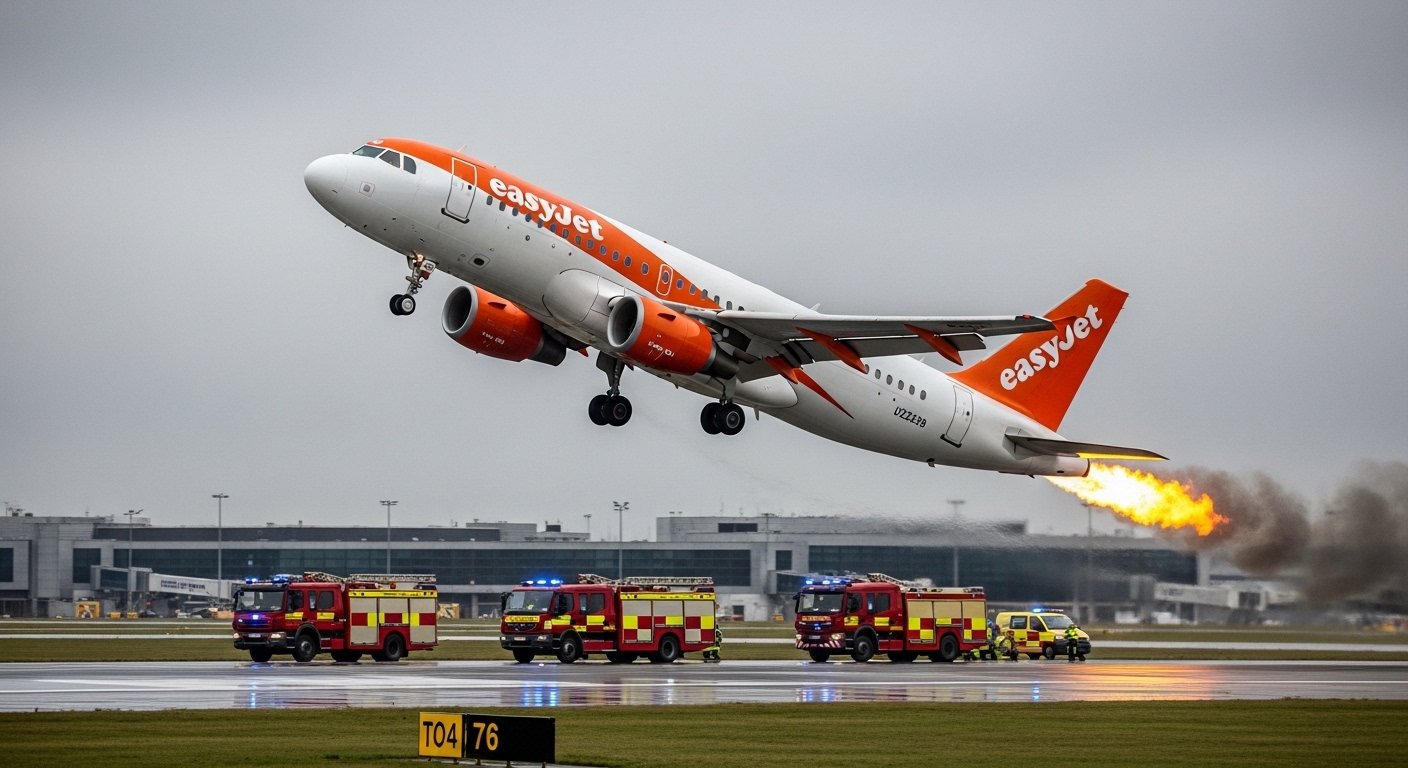
In what began as a routine evening hop from Scandinavia to the UK, easyjet flight u2238 emergency landing newcastle of a high-stakes medical drama over the North Sea. The flight, an Airbus A320-200 heading from Copenhagen to Manchester, was forced to make an unexpected and dramatic emergency landing at Newcastle International Airport (NCL) late on October 27, 2025.
Here is a breakdown of how the “squawk 7700” emergency unfolded, why the plane was diverted, and what happened to the passengers.
The “7700” Squawk: Declaring an Emergency
The flight departed Copenhagen Airport (CPH) just after 10:00 PM local time. While cruising at Flight Level 380 (approximately 38,000 feet) and approaching the UK coastline, the situation aboard changed rapidly.
The flight crew activated the universal transponder code 7700. This code is an international signal to air traffic control that the aircraft is facing a general emergency, requiring immediate priority handling.
Once the 7700 code was transmitted, air traffic controllers immediately prioritized the flight, clearing a direct path to the nearest suitable airport: Newcastle.
Why Newcastle? The Medical Emergency
According to aviation tracking data and statements from the airline, the nature of the emergency was a “passenger welfare issue” or a serious medical emergency. A passenger aboard the flight required urgent medical attention that could not wait for the flight to reach Manchester, which was still roughly 30 minutes away over the Pennines.
The pilot made the decisive call to divert to Newcastle. The airport, located on the North East coast of England, offered the closest runway with adequate medical facilities.
-
Diversion Logistics: The decision to divert is never taken lightly. In this instance, it was strictly a matter of life-saving speed. As the easyJet flight made its approach, other inbound traffic—specifically Air France flight AFR1558—was placed in a holding pattern to give the emergency aircraft priority landing rights.
The Landing and Immediate Response
At approximately 10:45 PM GMT, Flight U22238 touched down safely on Runway 25 at Newcastle International Airport.
Unlike a standard arrival, the aircraft was immediately met by a fleet of emergency vehicles and a waiting medical team. Paramedics rushed aboard to provide initial treatment to the passenger who had fallen ill.
What happened to the passenger?
Medical professionals assessed and stabilized the individual at the scene. While specific details regarding the passenger’s health were not released due to medical privacy regulations, reports indicate that the passenger was stable enough to be handed over to the care of the North East Ambulance Service (NEAS) for further treatment.
The Aftermath: Continuing to Manchester
With the medical emergency resolved, the aircraft had to be refueled and prepared for the final short leg of its journey.
After a delay of just over an hour on the tarmac in Newcastle, the Airbus A320-200 (registered G-EZPB) was cleared for departure.
-
Departure from Newcastle: 12:02 AM (October 28)
-
Arrival in Manchester: 12:29 AM
The remaining 178 passengers and six crew members eventually arrived in Manchester, landing safely albeit much later than their originally scheduled arrival time of 10:45 PM.
Airline Statement and Official Response
easyJet confirmed the incident shortly after it occurred, prioritizing transparency regarding the safety of their passengers.
A spokesperson for the airline stated:
“Flight EZY2238 from Copenhagen to Manchester on October 27 diverted to Newcastle, due to a customer onboard requiring urgent medical attention. The customer was met by medical services on arrival, and the flight continued to Manchester. The safety and wellbeing of our customers is always easyJet’s highest priority.”
A Testament to Safety Protocols
While the emergency landing at Newcastle was an unexpected disruption for holidaymakers and business travelers, the incident serves as a case study in effective aviation safety.
The successful handling of Flight U22238 highlights the rigorous training of airline crew, the swift decision-making of pilots, and the coordination between air traffic control and ground emergency services. When a life hangs in the balance at 38,000 feet, a diversion is not just an inconvenience—it is a lifesaving necessity.