

Table of Contents
ToggleWhen we think of Toronto, the largest city in Canada, we often picture the iconic CN Tower piercing the clouds, the bustling streets, or the frigid winter winds. However, one of the most defining yet overlooked aspects of life in this diverse metropolis is its sunlight.
Toronto is a city of extreme contrasts. It is famous for its sweltering, humid summers and its bone-chilling, snowy winters. But hidden within these temperature swings is a fascinating story of light. From the “golden hour” over Lake Ontario to the short, muted days of December, understanding Toronto’s solar patterns is key to understanding the city itself.
This article provides a complete breakdown of Toronto’s monthly sunlight data, explains why the light changes so dramatically, and compares the “Big Smoke” to other major cities around the world in terms of solar irradiance and sunshine hours.
Toronto’s Monthly Sunlight Breakdown
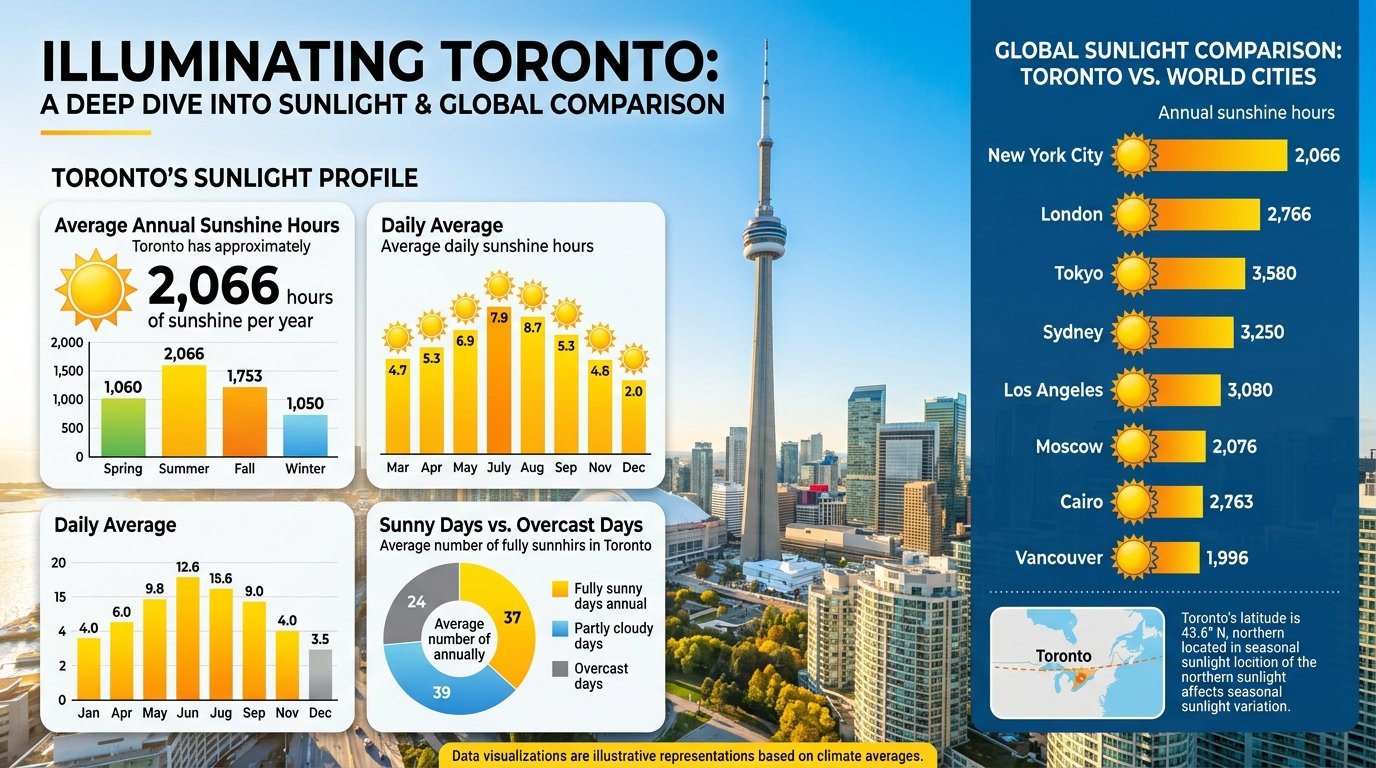
Toronto experiences four distinct seasons, and its sunlight hours shift radically throughout the year. The city receives an average of 2,070 hours of sunshine annually . However, the distribution of this light is highly uneven.
The Peak of Summer
In July, Toronto is bathed in light. The city enjoys an average of 280 total sunshine hours across the month, translating to approximately 9.3 to 11 hours of sunlight per day . Because Toronto is at a northern latitude (approx. 43.7° N), the days are long. The sun rises early, and it doesn’t set until nearly 9:00 PM, giving residents and tourists ample time to enjoy the waterfront and patios.
The Depth of Winter
The opposite occurs in December. The city hits its lowest point with only 78 total sunshine hours—averaging just 2 to 3 hours of sunlight per day . This combination of low sunlight and cold temperatures contributes to the “Seasonal Affective Disorder” (SAD) many Torontonians experience, making the summer months psychologically precious.
Detailed Monthly Table
Here is the month-by-month breakdown of average daily sunlight and daylight hours based on climate data :
| Month | Avg. Daily Sunshine (Hours) | Avg. Daily Daylight (Hours) | UV Index (Max) |
|---|---|---|---|
| January | 2.5 – 3.8 | 9 | 1 |
| February | 4.0 – 5.0 | 11 | 2 |
| March | 5.0 – 7.0 | 12 | 3 |
| April | 6.0 – 8.0 | 13 | 5 |
| May | 7.0 – 10.0 | 15 | 7 |
| June | 9.0 – 11.0 | 15 | 8 |
| July | 9.0 – 11.4 | 15 | 8 |
| August | 8.0 – 10.0 | 14 | 7 |
| September | 6.0 – 8.0 | 12 | 5 |
| October | 5.0 – 6.0 | 11 | 3 |
| November | 3.0 – 4.5 | 10 | 2 |
| December | 2.0 – 3.3 | 9 | 1 |
*(Note: Ranges are due to different data collection methods; July often shows as high as 11.4 hours in some datasets, though official averages often cite 9-10 hours for daily sun)* .
Why Does Toronto’s Light Change So Much?
The drastic swing in Toronto’s sunlight is due to the Earth’s axial tilt. As the Earth orbits the sun, the Northern Hemisphere tilts toward the sun during the summer (creating long days) and away from it during the winter (creating short days) .
-
The Summer Solstice (June 21): The sun is directly overhead at the Tropic of Cancer. Toronto receives about 15 hours and 25 minutes of daylight.
-
The Winter Solstice (December 21): The sun is overhead at the Tropic of Capricorn. Toronto receives only about 8 hours and 50 minutes of daylight.
-
Equinoxes (March & September): Day and night are nearly equal (approx. 12 hours each) .
The Science of Solar Energy (Irradiance)
While “sunshine hours” tell us how long the sun is up, Solar Irradiance tells us how strong the sun is. This is measured in Watts per square meter (W/m²). Toronto has a moderate solar potential.
According to recent climate studies, Toronto has a mean solar irradiance of approximately 153.7 W/m² . To put this in perspective:
-
Abu Dhabi (UAE): ~240 W/m² (Intense, desert sun)
-
Guayaquil (Ecuador): ~263 W/m² (Very high equatorial sun)
-
Toronto (Canada): ~154 W/m² (Moderate)
-
London (UK): ~118 W/m² (Often overcast)
-
Brussels (Belgium): ~126 W/m²
This data confirms why solar panels in Toronto are effective, but less productive than they would be in California or the Middle East.
Global Sunlight Comparison
How does Toronto stack up against the rest of the world? It sits firmly in the “mid-range.” It is significantly sunnier than Northern Europe but much darker than the Equatorial or Desert zones.
Sunny Destinations (High Sunlight)
Cities like Adelaide, Australia (2,770 hours/year) and Barcelona, Spain (2,530 hours/year) see significantly more sun than Toronto. They benefit from Mediterranean climates and lower latitudes, resulting in shorter winters and less cloud cover .
The Overcast & Polar Regions (Low Sunlight)
Tromsø, Norway, located in the Arctic, receives only about 1,270 hours of sunlight annually. During the Polar Night, the sun doesn’t rise for weeks, making Toronto seem tropical by comparison .
The “Sunlight” Comparison Table
| City | Annual Sunshine Hours | Average Solar Irradiance (W/m²) | The “Feeling” |
|---|---|---|---|
| Toronto, Canada | 2,070 | ~154 | Four distinct seasons; dark winters, glorious summers |
| Vancouver, Canada | 1,940 | ~142 | Less than Toronto; very cloudy/rainy winters |
| London, UK | 1,673 (approx) | ~118 | Low light, high overcast |
| Barcelona, Spain | 2,530 | ~190+ | High sun; long summer days |
| Singapore | ~2,100 | ~168 | Consistent 12-hour days; hot year-round |
Practical Tips for Toronto Visitors
If you are planning a trip to Toronto, use the sunlight data to your advantage:
-
Summer (June-Aug): Sunscreen is a must. Even if it isn’t scorching hot, the UV Index hits 8 or 9 . The sun is strong enough to cause burns during long exposure at the waterfront.
-
Winter (Nov-Feb): Vitamin D is your friend. With only 2-3 hours of weak sun, many locals take supplements. This is the time for “hygge”—embracing the cozy indoor atmosphere.
-
Photography: The “Golden Hour” (just after sunrise or before sunset) varies wildly. In December, you might catch it at 4:00 PM. In June, you have to wait until 8:30 PM.
-
Seasonal Affective Disorder (SAD): The drop from 9 hours of sun in August to 5 hours in October is rapid. Visitors moving from sunnier climates often feel this shift. A light therapy box can be helpful for long-term stays .
Conclusion
Toronto is a city of light and shadow—literally. With over 2,000 hours of sun annually, it is far from a gloomy city, yet its Northern latitude ensures a dramatic seasonal dance. From the 11-hour days of July to the brief glimmers of December, the “Toronto Sunlight” dictates the rhythm of life, telling residents when to play outside and when to hunker down. Compared to the rest of the world, it strikes a perfect balance: sunnier than Europe, less intense than the equator, and uniquely Canadian in its extremes.