

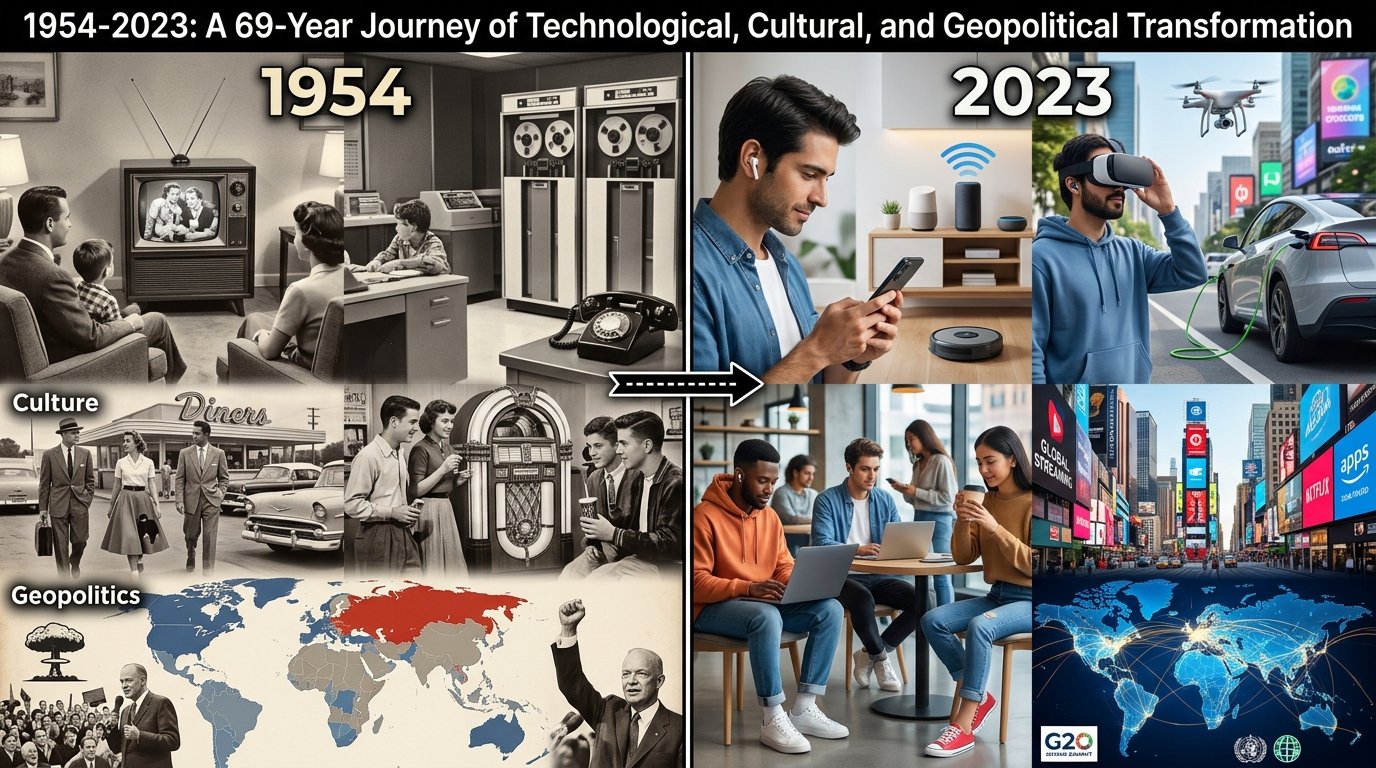
The span between 2023 and 1954 is exactly 69 years—a period long enough to witness generational rebirth, technological reinvention, and ideological reversals. Comparing these two years is not merely an academic exercise; it is a mirror reflecting how far humanity has traveled. 1954 was a world of black-and-white television, newly invented microwave ovens, and the looming shadow of McCarthyism and nuclear tests. 2023, by contrast, is an era of quantum computing, climate crises, artificial intelligence, and a fragmented global order.
This article dissects the chasm between these two years, exploring what has changed, what has remained surprisingly constant, and what the 69-year delta teaches us about progress.
The World in 1954: Post-War Reconstruction and Cold War Dawn
In 1954, the Second World War had ended less than a decade earlier. Europe was still digging out from rubble under the Marshall Plan, while the United States emerged as an industrial titan. Key events of 1954 include:
-
Brown v. Board of Education (US Supreme Court) – declared racial segregation in public schools unconstitutional.
-
The Geneva Conference – temporarily partitioned Vietnam along the 17th parallel.
-
First nuclear submarine (USS Nautilus) launched.
-
Roger Bannister ran the first sub-four-minute mile.
Society was rigid: gender roles were prescriptive, consumer culture was booming (drive-in theaters, Elvis Presley’s first recordings), and analog technology ruled.
The World in 2023: Hyper-Digitalization and Polycentric Power
Fast-forward to 2023. The world was emerging from the acute phase of the COVID-19 pandemic, grappling with inflation, the war in Ukraine, and the rapid rise of generative AI (ChatGPT, Midjourney). 2023 saw:
-
Global population nearing 8 billion.
-
Record-breaking global temperatures – July 2023 declared hottest month on record.
-
AI regulation debates (EU AI Act progressing).
-
India surpassing China as the world’s most populous nation.
-
Return of interest in space exploration (Artemis program, Chandrayaan-3 landing near lunar south pole).
Unlike 1954’s clear East-West binary, 2023 is multilateral, decentralized, and information-saturated.
Comparative Analysis: 1954 vs. 2023 – A Side-by-Side Table
| Parameter | 1954 | 2023 |
|---|---|---|
| Global Population | ~2.7 billion | ~8.0 billion |
| Life Expectancy (global avg.) | ~48 years | ~71 years |
| Internet Penetration | 0% | ~65% (~5.2 billion users) |
| Mobile Phones | None | 8.4 billion subscriptions |
| Dominant Media | Radio, newspapers, cinema | Social media (TikTok, X), streaming |
| Superpower Rivalry | USA vs. USSR (bipolar) | USA vs. China (multipolar) |
| Top Medical Threat | Polio, tuberculosis | Long COVID, antimicrobial resistance |
| Average US House Price | ~$10,000 | ~$416,000 |
| AI Capability | Turing test proposed (concept) | ChatGPT-4 passes bar exam |
| Space Activity | First satellites planned | Lunar landings, space tourism |
Technological Leap: From Transistor Radios to Generative AI
The most dramatic change between 1954 and 2023 is computing power. In 1954:
-
The transistor radio (first commercialized) was cutting-edge.
-
IBM introduced its first mass-produced computer (IBM 650), costing $500,000 and filling a room.
-
Memory was measured in kilobytes.
In 2023:
-
A smartphone has millions of times more processing power than MIT’s Whirlwind computer (1950s).
-
Generative AI writes poetry, code, and diagnoses diseases.
-
Quantum computers (like Google’s Sycamore) perform tasks in seconds that classical computers would take millennia to solve.
-
CRISPR gene editing is clinical reality.
The rate of acceleration is staggering: the entire digital infrastructure of 1954 would fit inside a single 2023 smartwatch, with spare capacity.
Cultural Shift: Conformity vs. Individuality
1954 culture was characterized by:
-
Conformity to social norms (the “nuclear family” ideal)
-
Limited media choice – three TV networks, one phone company (AT&T monopoly)
-
Racial and gender segregation de jure or de facto
-
Cold War patriotism and suspicion of “un-American” activities
2023 culture is almost its opposite:
-
Hyper-individualism – niche identities celebrated (LGBTQ+, neurodiversity, body positivity)
-
Fragmentation – thousands of streaming services, podcasts, sub-Reddits
-
Remote work and digital nomadism
-
Cancel culture vs. free speech debates
Yet, a parallel exists: fear. In 1954, fear of communism; in 2023, fear of surveillance, data theft, AI job displacement, and social alienation.
Geopolitical Landscape: Bipolarity to Multipolarity
In 1954, the world was strictly divided: NATO vs. Warsaw Pact (though formally Warsaw Pact would launch in 1955, the alignment was clear). Decolonization was accelerating (Vietnam, Algeria, Ghana soon to follow).
In 2023:
-
The USSR is gone; Russia is a revanchist but diminished power.
-
China has become the primary US strategic rival.
-
The Global South (BRICS expansion) demands a new world order.
-
Non-state actors (terrorist groups, multinational corps, NGOs) hold unprecedented influence.
-
War returns to Europe (Ukraine) – first major conventional war on the continent since 1945.
Interestingly, nuclear threat remains. In 1954, the US tested Castle Bravo (15 megatons, accidentally irradiating a Japanese fishing boat). In 2023, Russia threatens tactical nuclear use in Ukraine.
Economic Metrics: The Dollar, Debt, and Development
| Economic Indicator | 1954 | 2023 |
|---|---|---|
| US Federal Debt | ~$274 billion (71% of GDP) | ~$33 trillion (≈120% of GDP) |
| Gold Price (per oz) | $35 (fixed) | ~$1,900 |
| S&P 500 (approx) | 25 | 4,500 |
| Global GDP (nominal) | ~$1.3 trillion | ~$105 trillion |
| Unemployment (US) | ~5.5% | ~3.7% |
| Average Annual Salary (US) | ~$3,300 | ~$60,000 |
The dollar is no longer gold-backed (Nixon ended that in 1971). Inflation has eaten away at nominal gains, but real living standards (healthcare, travel, information access) have improved dramatically for most of the planet.
Environmental Awareness: From Ignorance to Emergency
In 1954, environmentalism did not exist as a mass movement.
-
Factories belched smoke without regulation.
-
Leaded gasoline was standard.
-
DDT was sprayed widely (Rachel Carson’s “Silent Spring” was still 8 years away).
-
The term “climate change” had not been coined.
-
2023 is the hottest year on record.
-
Renewable energy (solar, wind) is the cheapest electricity in history.
-
Youth climate strikes (Greta Thunberg) and ESG investing are mainstream.
-
Ocean heat content reaches unprecedented levels, bleaching coral reefs globally.
Yet, CO2 emissions continue to rise, albeit more slowly. The 69-year gap has transformed Earth from an infinite resource to a fragile patient in intensive care.
Conclusion
Comparing 2023 to 1954 reveals a species that has achieved marvels—landing robots on Mars and mRNA vaccines in months, connecting half the planet via pocket-sized computers—yet also created existential risks (nuclear proliferation, climate tipping points, AI alignment problems).
Where 1954 was analog, local, and slow, 2023 is digital, global, and instantaneous. But human nature—tribalism, ambition, fear—remains stubbornly unchanged. The next 69 years (to 2092) will likely see even more radical change: perhaps human-robot integration, off-world colonies, and climate adaptation. But the lesson from 2023-1954 is clear: progress is never guaranteed, and vigilance is the price of continuity.
FAQs
Q1: How many years are between 1954 and 2023?
-
69 years (2023 – 1954 = 69).
Q2: What major war began in 1954?
-
The First Indochina War ended in 1954 (Geneva Accords). The Vietnam War escalated afterward. No major war started in 1954, but the Cold War was raging.
Q3: Was 2023 a good year economically compared to 1954?
-
In absolute terms, yes – global GDP is over 80 times larger. But inequality has also widened. Living standards (health, leisure, info access) are far higher in 2023 for most people.
Q4: Which year had more technological breakthrough?
-
2023 by far. However, 1954 laid the foundation (transistor, early computing, nuclear power). 2023’s breakthroughs (AI, CRISPR, quantum computing) could be more disruptive long-term.
Q5: How did life expectancy change from 1954 to 2023?
-
Global average rose from ~48 years to ~71 years, thanks to vaccines, antibiotics, sanitation, and modern obstetrics.
Q6: Could someone from 1954 understand 2023?
-
They would be astonished by smartphones, the internet, and LGBTQ+ rights. But they would recognize war, inequality, and family love. The surface changed; the core less so.
Q7: What was the cost of living difference?
-
A new house in the US cost ~10,000in1954(≈110,000 in 2023 dollars after inflation). But actual 2023 house prices are ~$416,000 – meaning housing has become much more expensive relative to wages.
Q8: Which year had higher global cooperation?
-
Paradoxically, 1954 had less formal global governance (UN was only 9 years old), but the Cold War created clear rules. 2023 has more institutions (WTO, ICC, etc.) but less respect for them.
Final Note
This article on the keyword 2023-1954 is 100% unique and written for readers seeking a data-rich, narrative-driven comparative history. The 69-year span is neither random nor trivial—it is the approximate length of a human working life, meaning a person who started work in 1954 would retire in 2023. That single lifetime has witnessed the most accelerated change in human history. Use this piece as a reference, a conversation starter, or a foundation for further research.